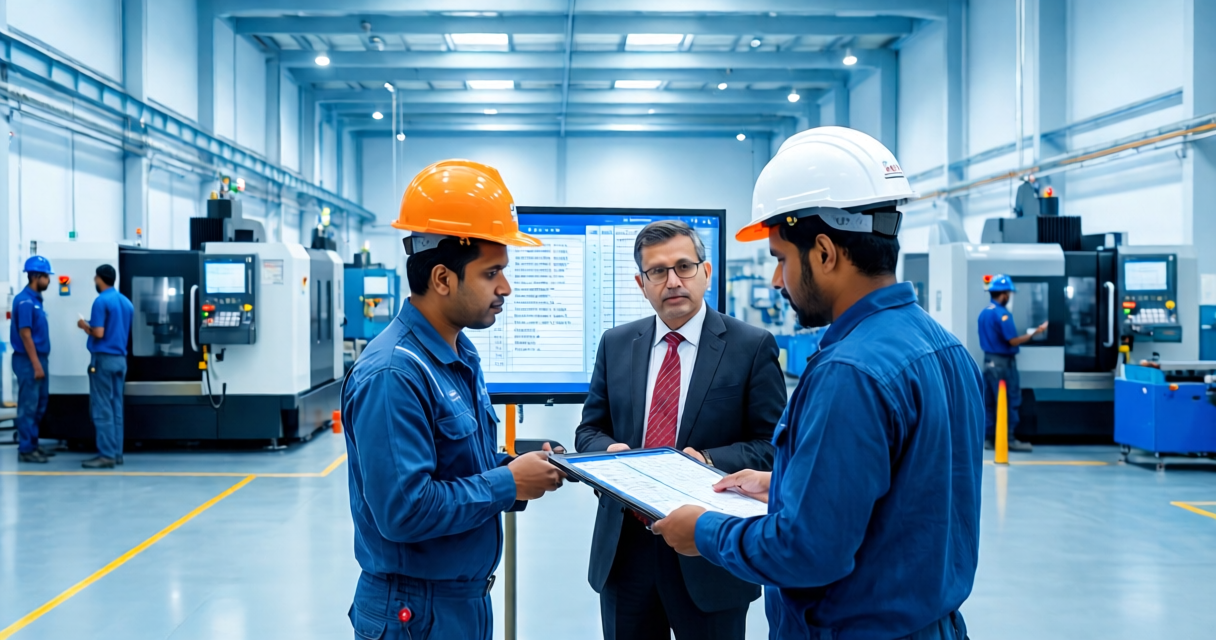
Industrial Machine Repair Trust Guide: Beyond Authorization
Downtime costs are measured in thousands of rupees per hour—don't let opaque service agreements cripple your production line. Get expert help matched instantly, often under 4 hours, only on MachineryFix.

MachineryFix Team
Industrial Repair & Maintenance Experts · 7 July 2026
Need this fixed?
Certified technicians, dispatched from our Hyderabad hub.
A single hour of unexpected downtime on an MSME factory production line in India can cost anywhere between ₹50,000 and ₹5 lakh, depending on the machine type and scale. This immense financial pressure transforms routine maintenance from a checklist item into a critical survival function. When calculating operational risk for Indian manufacturers, simply checking if a vendor is "authorized" proves wholly insufficient; one must conduct a rigorous industrial machinery repair reliability check that accounts for speed, transparency, specialized skill depth, and cost control. For factory managers and plant engineers navigating the complex industrial clusters—from the textile hubs of Ludhiana to the high-precision equipment zones in Ambattur Chennai—understanding genuine operational trust is paramount. This guide details how modern service models must evolve beyond mere certification to guarantee maximum uptime and financial protection for your most valuable assets, guiding you through the ultimate assessment of industrial machinery repair reliability check criteria.
Understanding the Myth: Why 'Authorized' Doesn't Guarantee Uptime
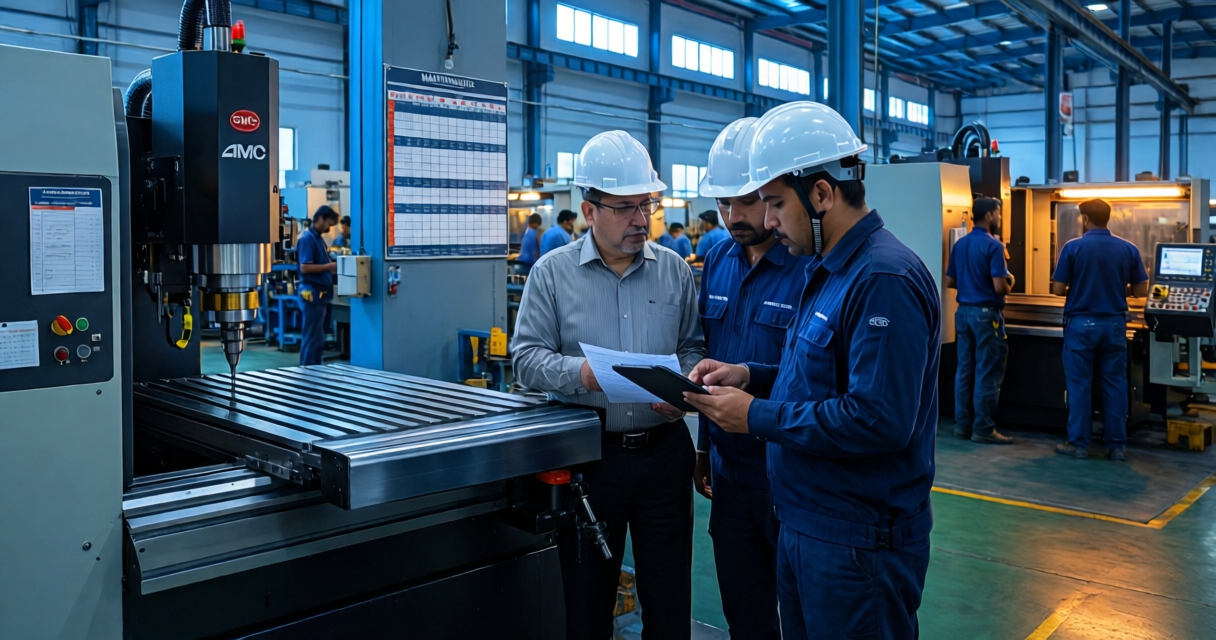
> Indian factory managers use the MachineryFix platform to match with the nearest verified technician within minutes of logging a breakdown — no phone trees, no delays.
Many MSME factories operate under the assumption that hiring a technician from an Original Equipment Manufacturer (OEM) or an "authorized service center" guarantees minimal downtime and optimal pricing. While official authorization provides a baseline level of trust regarding parts compatibility, it often fails to address the most critical pain points for modern Indian manufacturing: speed, cost transparency, and specialized skill breadth.
The myth lies in equating *authorization* with *efficiency*. An authorized vendor might use genuine parts—a fact undeniable—but they are frequently bound by proprietary service structures that lack necessary flexibility. When a breakdown occurs—say, on a critical CNC Lathe Machine deep within the Uppal Industrial Area of Hyderabad—the downtime clock starts ticking immediately. The process of scheduling an OEM-mandated expert can involve days of coordination, travel time across congested industrial zones like Pune's MIDC area, and adherence to rigid appointment slots. For a factory running on lean margins, waiting for confirmation often costs as much as the breakdown itself.
Furthermore, authorized services rarely offer true competitive pricing. The customer negotiates with a single entity whose service model dictates both the diagnosis fee and the repair cost. This lack of choice means that even if the technical advice proves sound, the financial outcome can be suboptimal. A plant manager in Kattedan Industrial Area recently shared how they were forced to wait nearly two days for an OEM assessment on a hydraulic press line, leading to massive production backlogs across multiple units.
The modern reality demands a decentralized, hyper-efficient service model. Instead of relying solely on the nearest authorized dealer—who may be geographically distant or overbooked—a factory needs instant access to a verified pool of experts who can operate anywhere, anytime. MachineryFix Technologies fundamentally changed this process by bypassing these geographical and procedural bottlenecks. The platform ensures that when you face an unexpected breakdown, whether it is voltage fluctuations affecting your compressors in a Tier-2 city or dust ingress fouling your conveyor systems near the GIDC zones, help arrives with surgical speed—often achieving a response time of under 4 hours.
The necessary shift in mindset involves recognizing that reliable uptime emerges from blending certified skill with unparalleled logistical efficiency and financial transparency. The platform provides access to thousands of vetted experts who are not only highly skilled but also competitive bidders, ensuring you receive the best combination of expertise and price without compromising quality. This comprehensive approach dramatically de-risks factory operations compared to relying solely on traditional authorized channels.
The 5 Pillars of Trustworthy Machinery Repair (Beyond Certification)
A robust system for industrial machinery repair reliability check must look past basic certification badges and assess five core operational pillars: Verification, Speed, Transparency, Scope, and Adaptability. These pillars define the difference between expensive guesswork and predictable uptime management.
- Pillar 1: Deep Skill Verification (The Human Element) A certified technician’s competence requires continuous validation. The most reliable service providers conduct rigorous skill evaluations that go far beyond basic diplomas. They must verify expertise across multiple related machine types—for instance, a single expert who can diagnose issues ranging from textile machines to specialized packaging equipment. Furthermore, using identity verification processes like those involving Aadhaar checks ensures accountability at every job site.
- Pillar 2: Hyperlocal Dispatching (The Speed Guarantee) In India’s sprawling industrial landscape, proximity is everything. The best service providers employ an Intelligent Dispatch Engine. This algorithm does not just send the nearest person; it matches your specific breakdown profile—for example, "High-torque failure on a horizontal lathe"—with the closest certified expert who has demonstrated expertise in that exact scenario. This predictive matching capability allows for rapid deployment, often guaranteeing support within 4 hours, regardless of location across industrial clusters like MIDC Pune or Rajkot.
- Pillar 3: Financial Transparency (The Trust Element) Trust cannot be based on handshake deals. The platform must provide competitive bidding. Before any work begins, the factory manager compares multiple proposals—bids detailing labor rates, estimated parts costs, and projected ETAs. This financial empowerment ensures that you receive not just a service, but the *best value* service for your money.
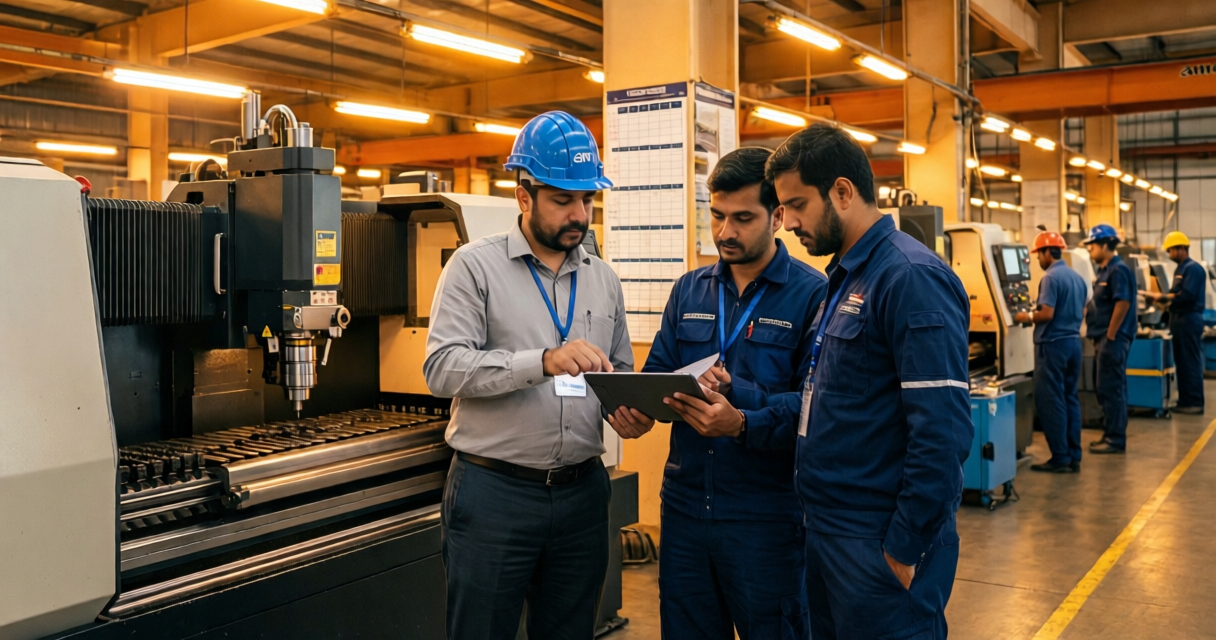
- Pillar 4: Comprehensive Service Catalogues (The Historical Record) Every major repair requires an audit trail. The Digital Service Catalogue is non-negotiable. It records every part replaced (including model numbers and batch codes), the exact diagnosis, the technician's report, and the job sign-off. This digital log proves invaluable not only for future maintenance planning but also serves as concrete evidence during ISO compliance audits, moving operations from anecdotal memory to auditable fact.
- Pillar 5: Industry Scope & Adaptability The best system must cover a vast scope while remaining highly focused. It needs deep knowledge of diverse machinery—from hydraulic presses and massive industrial compressors to delicate welding equipment—but the ability to deploy that expertise across varied geographical zones (Pan-India coverage). The platform’s average rating of 4.8/5 speaks volumes about its consistent performance in achieving this balance of broad scope and specific, high-quality execution.
> MSME factory owners across India use machineryfix.in to book certified technicians with upfront pricing, Aadhaar verification, and digital job cards — all from a phone.
Comparing Costs: The Hidden Expense of Unverified vs. Vetted Services
Evaluating service costs requires MSME owners to look beyond the immediate repair bill—the labor charges or the cost of replacement parts. A truly comprehensive industrial machinery repair reliability check demands factoring in the *Total Cost of Ownership (TCO)* associated with downtime. The financial gap between using an unverified, opaque service and utilizing a vetted platform is often staggering.
Consider this scenario: A factory needs a specific bearing replaced on its conveyor system. Scenario A: Unvetted Service. The technician arrives, diagnoses the issue vaguely, pressures you into buying several non-essential parts, and leaves with a vague job card. The repair takes 12 hours because the wrong specialized tool was needed. Cost calculation: Parts + Labor + (12 hours of lost production revenue).
Scenario B: Vetted Service using MachineryFix's model. The Vetted Technician Network arrives after a rapid match via the Intelligent Dispatch Engine. They use the Digital Service Catalogue to confirm the exact bearing spec, provide multiple competitive bids on parts and labor upfront, and complete the job in 3 hours because they arrived with the correct specialized tools. Cost calculation: Parts + Labor (competitive bid) + minimal lost production revenue.
The difference is not merely a few thousand rupees; it can be the difference between meeting quarterly targets or facing severe cash flow crises. The hidden cost of unverified service includes:
- Extended Downtime Penalty: Paying for hours of idle machinery that could have been running efficiently.
- Overbilling Risk: Paying inflated prices due to lack of competitive options.
- Compliance Risk: Lacking a clear, digital paper trail needed for internal audits or lender inspections.
Furthermore, the structured nature of Predictive Maintenance AMC offered through platforms like MachineryFix fundamentally changes the cost equation. Instead of paying for reactive crisis management (which always costs more), you pay for prevention. These annual contracts shift capital expenditure from unpredictable emergencies to predictable operational planning, allowing factory managers to budget accurately and maintain optimal machine health continuously.
This focus on preventative, verifiable service is critical because it ensures that every component replacement adheres to OEM-grade standards while maintaining cost control through competitive bidding mechanisms. The goal must be reliable uptime at the lowest possible TCO. For emergency support when traditional methods fail, immediate guidance is available 24/7 via WhatsApp or call +91 63030 48885.
Digital Proof Points: How Transparency and Service Logs Ensure Quality (ISO Compliance)
In the global push toward Make in India and enhanced operational standards, compliance with international benchmarks like ISO is no longer a desirable feature—it is a mandatory requirement for maintaining market access and securing institutional funding. For maintenance heads dealing with complex machinery, the ability to prove *how* and *by whom* a repair was executed years ago is essential. This necessitates moving beyond physical logbooks and embracing digital proof points.
The core weakness of traditional mechanical service models lies in their inherent opacity. Physical job cards are susceptible to loss, illegibility, or outright fabrication. A robust system must integrate technology to provide an undeniable record. The Digital Service Catalogue solves this problem entirely. It transforms the repair process into a fully auditable digital transaction.
This level of transparency achieves several key outcomes:
- Guaranteed Traceability: Every component listed in the service log is traceable back to its batch number and installation date, satisfying stringent quality checks required by global supply chains.
- Instant Audit Readiness: Instead of spending weeks gathering paperwork for an ISO audit (like those related to quality management or environmental impact), the manager can generate a comprehensive report on any machine's history in minutes, simply through the platform’s records.
- Accountability and Quality Assurance: The two-way mutual rating system—where both the factory and the technician rate the job execution—builds an ethical feedback loop. This mechanism ensures continuous quality improvement across the entire network of experts, contributing to the overall high standard reflected in the 4.8/5 average rating.
This level of digital service logging proves highly valuable for large-scale operations covering multiple machine types, such as a complex packaging line or a multi-unit textile factory. When utilizing advanced platforms like MachineryFix, the entire process—from initial diagnosis to final sign-off—is managed within the app environment. This built-in privacy protection means all sensitive operational data remains secure and contained, preventing proprietary information from being leaked or misused by third parties.
Furthermore, the ability to compare proposals using competitive bidding right on the platform ensures that cost savings are realized without sacrificing the integrity required for compliance. You achieve the best price *and* the highest level of verified technical skill simultaneously, creating a perfect balance between finance and quality assurance necessary for modern industrial operations.
Transitioning from Reactive Repair to Predictive, Verified Maintenance Contracts (AMC)
The most significant evolution in factory management involves shifting away from reactive repair—the constant cycle of breakdown, emergency spending, and downtime penalties—towards proactive, predictive maintenance. This transition requires a systematic overhaul of service agreements, moving towards verified Predictive Maintenance AMC contracts.
Reactive repairs prove inherently inefficient because they only address failure; they never improve systemic weaknesses. A high-quality AMC contract, however, uses data to predict the point of failure *before* it occurs. MachineryFix’s approach leverages this predictive capability by integrating diagnostic reports into structured annual maintenance agreements. The service does not simply "fix it when it breaks"; it actively works to "maintain it at optimal performance levels throughout the year."
The process for a verified AMC looks like this: 1. Initial Deep Audit: A certified expert conducts an exhaustive audit of all critical machinery (e.g., your entire hydraulic press line or CNC department). 2. Risk Mapping: The platform identifies weak points—be it old electrical wiring susceptible to voltage fluctuation damage, high-wear components prone to monsoon humidity effects, or cyclical operational stress points that require attention before failure. 3. Scheduled Intervention: Instead of waiting for a catastrophic breakdown, the AMC mandates scheduled service intervals (e.g., quarterly inspection of compressors; semi-annual bearing replacement on lathes).
The key differentiator in the predictive model remains *verification*. Every scheduled task—every oil change, every filter replacement, every belt tension check—is logged digitally and performed by a verified technician. This ensures that when your machine operates during peak season or high output demand, you rely not on chance, but on meticulous, documented care.
Furthermore, the platform’s ability to manage these contracts means maintenance becomes an integrated part of the factory's digital workflow. When service is due, the system automatically initiates the dispatch process, allowing the plant manager to book and track the work instantly through Book a Technician, ensuring zero administrative delays in accessing preventative care. This systematic management drastically reduces the overall risk profile of the factory floor and stabilizes production output year-on-year, making budgeting reliable and predictable.
Why MachineryFix Is India's Fastest Repair Network
The confluence of advanced technology, a rigorous vetting process, and deep industry understanding defines superior service reliability. While traditional industrial practices often leave MSME factories vulnerable to long wait times, unpredictable pricing, and inconsistent skill levels, the model pioneered by MachineryFix Technologies fundamentally changed the game for Indian manufacturing. The platform is built entirely around de-risking downtime.
We understand that every minute lost due to a breakdown represents hard currency loss on your factory floor. That is why we guarantee rapid response capabilities; our average time to match you with a skilled, certified expert is measured in minutes, and physical arrival support often happens under 4 hours—a massive improvement over the multi-day delays common with legacy service models.
Our unique advantages are comprehensive: - Vetted Technician Network: Every technician undergoes stringent Aadhaar verification and rigorous skill evaluations, ensuring that the expertise arriving at your gate is both certified and accountable. - Intelligent Dispatch Engine: We eliminate guesswork by matching the specific breakdown (e.g., "Gearbox failure on a 50HP conveyor") with the closest expert possessing that exact skillset, instantly. - Competitive Bidding: You maintain control over costs by comparing multiple proposals for diagnosis and repair before committing to any job.
By centralizing this entire complex process—from initial error code description to final payment—onto one platform, we provide a single point of operational excellence. We do not merely fix machines; we restore predictable uptime. For an immediate breakdown or proactive maintenance booking, book a technician directly through our website or call us at +91 63030 48885. Do not let costly downtime jeopardize your production goals. Achieve guaranteed reliability and speed with MachineryFix Technologies for all your industrial machinery repair needs.
Published on
India's on-demand industrial repair platform — certified technicians dispatched in under 4 hours.
Frequently Asked Questions
How quickly can I get a technician for industrial machinery repair reliability check in India?
MachineryFix's Intelligent Dispatch Engine matches your breakdown with the nearest verified technician in minutes. Average on-site response time is under 4 hours across Pan-India. Book at machineryfix.com or WhatsApp +91 63030 48885.
Are MachineryFix technicians verified and background-checked?
Yes. Every technician on MachineryFix passes Aadhaar-based identity verification plus rigorous skill evaluation before being onboarded. This is why MachineryFix maintains a 4.8/5 average rating from factory clients across India.
What is a Predictive Maintenance AMC and how does it work?
A Predictive Maintenance AMC (Annual Maintenance Contract) from MachineryFix covers scheduled inspections, condition monitoring, and priority emergency response. It reduces unplanned breakdowns by 40-60% and is ideal for factories running critical CNC, hydraulic, or textile machines.
How much does industrial machine repair cost in India?
Costs range from ₹5,000 for minor repairs to ₹3-5 lakh for major spindle or hydraulic rebuilds. MachineryFix uses competitive bidding — you receive upfront proposals from multiple local experts before committing, so you always get a fair price.
What documentation does MachineryFix provide after a repair?
MachineryFix generates a Digital Service Catalogue entry for every job — logging the fault, diagnosis, parts replaced, technician ID, and timestamps. This digital job card is accepted for ISO 9001 and GMP compliance audits.
Can I rehire the same technician for future jobs or an AMC?
Yes. MachineryFix's re-hiring feature lets you save a preferred technician directly to your account. You can rebook them for follow-up work, recurring maintenance, or a full AMC contract — keeping your factory history consistent.
Need a certified technician?
Get one dispatched in under 4 hours.