Machinery Lifecycle: Scrap vs Buy New in Hyderabad MSME
Stop guessing on CAPEX decisions. This guide provides the structured TCO framework needed to decide if your machine needs a patch or a complete overhaul. Gain clarity and reduce downtime from days to under 4 hours with MachineryFix support.

MachineryFix Team
Industrial Repair & Maintenance Experts · 8 July 2026
Need this fixed?
Certified technicians, dispatched from our Hyderabad hub.
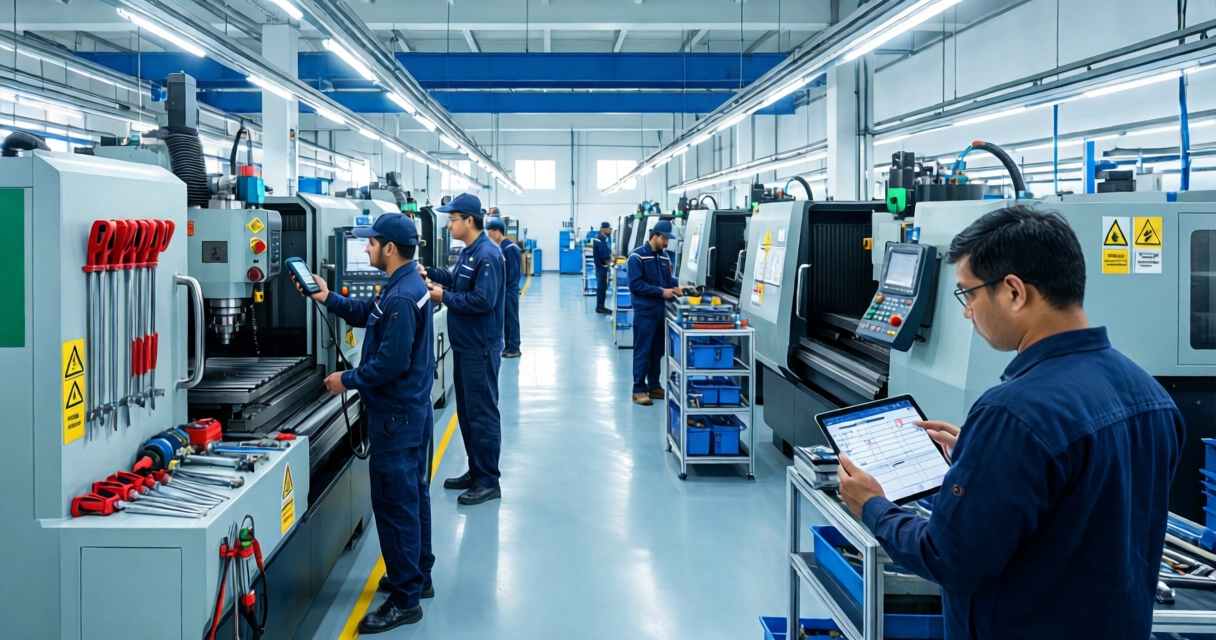
The true cost of factory downtime in India can escalate rapidly, often running from ₹50,000 up to ₹5 lakh per hour. For MSME manufacturers operating in critical clusters like Uppal Industrial Area, Kattedan, or MIDC Pune, understanding the Total Cost of Ownership industrial assets transcends simple accounting; it is a core survival strategy. When equipment fails—a lathe exhibiting chronic vibration or a hydraulic press sputtering unpredictably—the decision between extensive repair spending and outright replacement becomes paralyzing. This guide provides plant managers and factory owners with the data-driven framework necessary to move beyond guesswork, calculating the actual economic viability of every machine on the shop floor.
Defining Obsolescence—When Does 'Old' Become Economically Unviable?
> Indian factory managers use the MachineryFix platform to match with the nearest verified technician within minutes of logging a breakdown — no phone trees, no delays.
Reliability, not age or operating hours, defines when industrial equipment reaches its functional end point. Many MSME factories still operate based on intuition: "It worked fine last year." However, modern manufacturing demands data-driven precision. Obsolescence extends beyond simple rust; it reflects the escalating risk profile associated with outdated technology or components that are no longer readily sourced within India.
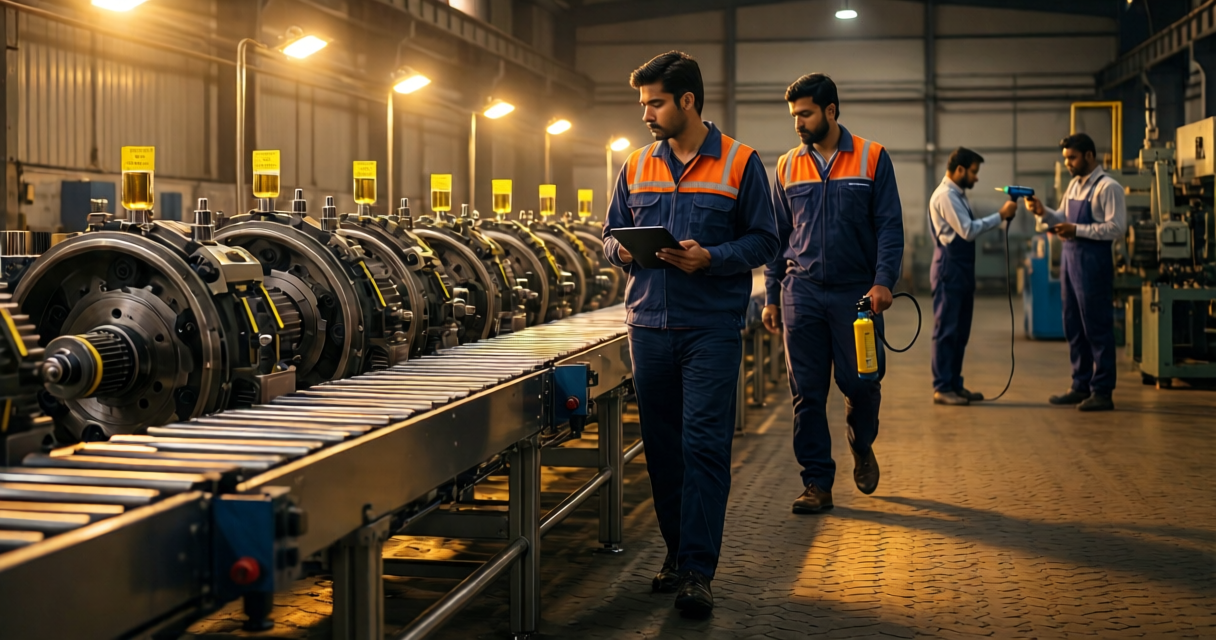
A key indicator of approaching unviability appears when routine maintenance costs and complexity start to outweigh the perceived residual value of the asset. Consider a conveyor system running through humid monsoon conditions: if the failure rate increases, requiring specialized parts from foreign suppliers with six-week lead times, the entire operation stalls while waiting for components. This scenario quickly demonstrates that downtime duration can become significantly more expensive than the initial purchase price difference between an old and new model. Moreover, older machinery often lacks modern safety features or energy efficiency ratings, leading to higher operational expenditures (OpEx) and non-compliance risks.
The transition from 'repairable' to 'scrap' demands rigorous calculation of asset health. Digital service logs provide critical insights here. These records do more than document a replaced part; they capture the diagnostics performed, the root cause of failure, and the machine’s overall performance metrics over time. By analyzing this accumulated data—a feature invaluable for ISO and compliance audits—owners can accurately track the machine's true reliability index. Instead of relying on gut feeling or general estimates, decisions are based on a verifiable, digitized history that distinguishes between age-related failure (predictable) and systemic design flaws (unfixable).
For instance, if repeated repairs show that the same bearing type fails within three months regardless of component quality, the TCO calculation must factor in not only the cost of the repair but also the *opportunity cost* of lost production hours. Making asset health visible and quantifiable empowers owners to proactively manage capital expenditure (CapEx), ensuring investment is directed toward maximum return, whether extending a reliable asset or acquiring a modern replacement.
The True Cost of Ownership (TCO) Model for Industrial Assets
The traditional approach to calculating machinery cost focuses narrowly on acquisition price and immediate running expenses—the purchase price plus electricity bills. This simplistic view fails entirely to capture the financial reality faced by Indian MSME manufacturers. A comprehensive understanding of Total Cost of Ownership industrial assets must incorporate hidden, yet significant, expenditures: downtime losses, specialized labor unavailability, inventory holding costs for spares, and emergency repair premiums.
The TCO model shifts the conversation from "How much does this cost to run?" to "What is the actual economic penalty if this fails right now?" When a critical piece of equipment—like a packaging machine in Ambattur Chennai—stops unexpectedly, the loss calculation extends far beyond just the hourly rate of the machine. It includes lost output volume, potential penalties for delayed orders, and the cost of expedited measures taken to restore service flow.
A robust TCO assessment helps procurement officers determine if investing in a slightly more expensive, but highly reliable, brand is financially sounder than consistently dealing with the high costs associated with patchwork repairs on an older unit. The integration of competitive bidding for services and parts ensures that the cost of repair itself remains fully transparent, feeding directly into the overall TCO score.
Furthermore, factoring in risk mitigation proves crucial. An asset exhibiting low inherent reliability poses a massive *risk cost*. If your current machine has an average downtime cycle of ten days per year, even if each breakdown costs ₹2 lakh, the annual risk expense alone reaches ₹20 lakhs—a figure often overlooked by standard accounting practices.
The solution involves achieving data transparency. The combination of an Intelligent Dispatch Engine and a vast network of Vetted Technician experts drastically reduces this inherent risk cost. Knowing that a certified expert can arrive within under four hours, regardless of the machine's location across the Pan-India service coverage area, transforms a catastrophic operational risk into a manageable logistical issue. For Indian factory owners who book a certified technician directly from their mobile device, upfront pricing and guaranteed rapid response effectively mitigate much of that financial uncertainty.
> MSME factory owners across India use machineryfix.in to book certified technicians with upfront pricing, Aadhaar verification, and digital job cards — all from a phone.
Repair vs. Replace: A Data-Driven Financial Comparison (ROI & Payback Period)
The classic dilemma—patching the old versus buying the new—is frequently driven by emotional decision-making rather than objective financial logic. Factory managers often favor repair because it appears to be a smaller, more immediate expenditure, yet this approach can lead to "repair creep," where temporary fixes mask fundamental structural failure.
To make an objective choice, one must calculate the Return on Investment (ROI) for both options and establish a clear Payback Period.
For Repair: Calculate the cumulative repair cost over three years versus the estimated remaining useful life (RUL) of the machine. If the total accumulated repair spend approaches fifty percent or more of the original asset value, the ROI for continued repair declines sharply. Additionally, one must account for the non-monetary cost: risk and downtime. A chronically failing machine adds unpredictable stress to operations.
For Replacement: Calculate not only the purchase price but also the long-term savings (OpEx reduction) derived from modern efficiency features, lower energy consumption, and superior uptime guarantees. The payback period is calculated by dividing the initial capital outlay by the annualized savings generated. If a new model saves fifteen percent on electricity and reduces downtime risk by eighty percent, its payback period might be aggressively short—perhaps within two to three years.
Detailed, objective data points are necessary to bridge this gap. Digital Service Catalogues allow owners to benchmark the repair costs of their old asset against industry standards for new equipment servicing. By comparing accumulated service logs and diagnostic reports, a procurement officer can definitively prove whether continued investment in an older unit is mathematically sound or merely financially sentimental.
Consider the scenario common in Ludhiana's textile cluster: An owner might be tempted to repeatedly overhaul a decades-old dyeing machine. The ability to provide real-time status updates and diagnostic reports, coupled with competitive bidding from multiple certified experts, forces objective comparison. If cumulative repair bids consistently exceed the cost of a comparable, energy-efficient new unit, the data points unequivocally toward replacement—a decision that moves away from fear and towards financial certainty.
Mitigating Risk with Predictive Maintenance: Extending Asset Life Safely
The most advanced approach to industrial asset management is neither reactive (fixing what broke) nor purely preventative (changing parts based on arbitrary timelines). It is predictive maintenance. This strategy uses data analytics—vibration monitoring, thermal imaging, and operational load tracking—to predict *when* a failure will occur, allowing repairs to be scheduled during planned downtime.
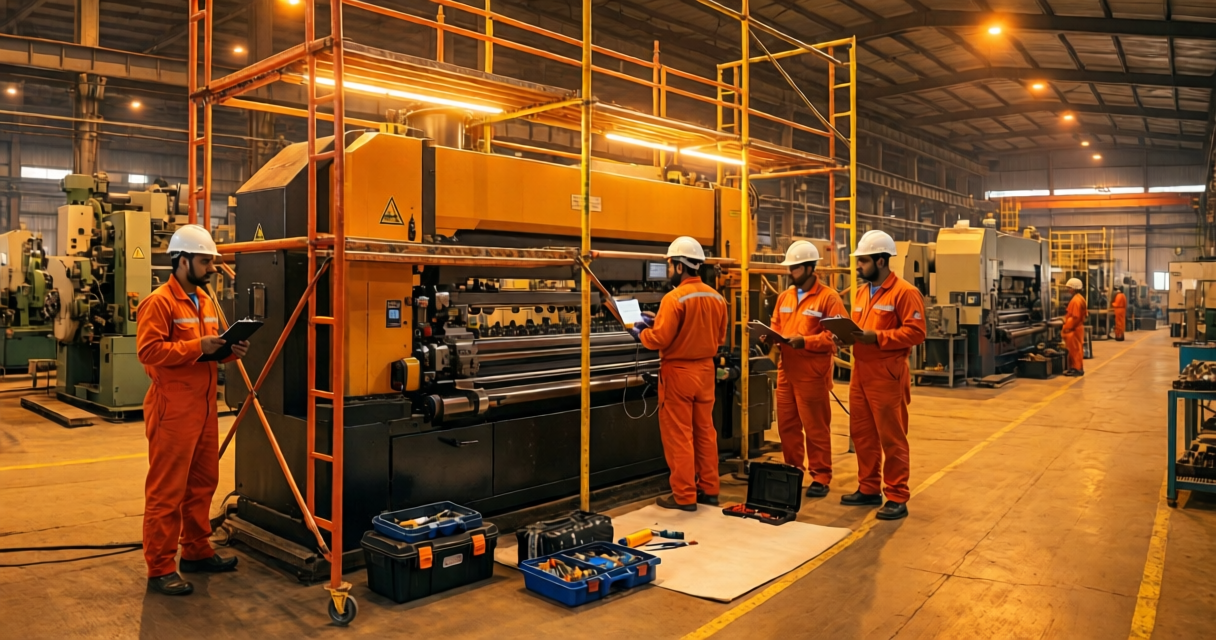
Predictive Maintenance AMC contracts are transformative for MSME manufacturers struggling with unpredictable breakdowns caused by voltage fluctuations or dust ingress. Instead of waiting for the motor bearing to seize, causing an emergency stoppage and high premiums, a predictive contract flags minor increases in vibration amplitude two weeks in advance. This allows maintenance heads to schedule precise component replacement during a planned weekend shutdown.
MachineryFix structures this predictability through its Predictive Maintenance AMC contracts. These structured annual agreements provide ongoing monitoring and preemptive servicing plans across the entire asset fleet—from CNC machines to hydraulic presses. The system transforms unpredictable operational risk into predictable, budgeted expenditure. This continuous cycle of monitoring, early warning, and scheduled intervention drastically improves the overall reliability index and helps maintain peak productivity year-round.
The benefits are manifold: - Extended asset lifespan without compromising safety standards. - Optimized inventory management for spares, reducing capital locked up in unnecessary stock. - Maximized utilization rate (Uptime %) of high-value assets.
This proactive approach is especially vital given India’s varied industrial climate. From the corrosive effects near coastal areas to extreme dust ingress in arid regions, anticipating failure points allows for customized mitigation strategies that generic maintenance schedules cannot achieve. A plant manager at Kattedan Industrial Area who adopted this method reported reducing average downtime from days to under four hours simply by being prepared *before* the breakdown occurred.
The Strategic Advantage of Digital Machinery Management in India's MSME Sector
The convergence of digital technology and industrial machinery maintenance fundamentally restructures how Indian factories operate. For small and medium-sized enterprises (MSMEs), adopting these technologies grants access to world-class operational efficiency once reserved for large multinationals. This shift empowers the local entrepreneur with global best practices, all managed through a single platform.
Digital service logs constitute more than just paperwork; they create institutional knowledge. They establish an immutable record of every action taken on a machine, forming a comprehensive asset digital twin within the system. For compliance and audit purposes—whether for ISO certification or local regulatory bodies—this level of detail is non-negotiable. It provides forensic proof of due diligence regarding asset upkeep.
Adopting platforms like MachineryFix addresses several core structural challenges unique to the Indian industrial landscape: 1. Skill Gap: The platform’s requirement for a Vetted Technician Network ensures that every expert is not just skilled, but also rigorously evaluated and verified through Aadhaar checks, solving the problem of unreliable labor sourcing. 2. Geographical Fragmentation: By maintaining pan-India service coverage and leveraging the Intelligent Dispatch Engine, it overcomes the geographical challenge of finding specialized expertise in Tier 2 or Tier 3 industrial clusters. 3. Trust Deficit: The mutual rating system and full transparency, including visibility into weekly technician payouts, build trust between the factory owner and the service provider—a critical factor for sustained B2B relationships.
This entire digital ecosystem ensures that every transaction is tracked, analyzed, and optimized for cost efficiency. When a plant manager needs to quickly secure specialized support, they can use the app's features to compare bids instantly before committing to work, guaranteeing competitive pricing and maintaining financial control—a key takeaway from factory owners like Priya Kumari in Jeedimetla Cluster who noted that "Competitive bidding saved us 20% on our last repair."
The Economic Imperative of Rapid, Transparent Machinery Support
The economics of machinery management demand speed, transparency, and certified expertise. The time elapsed between a breakdown occurring and the machine being back online determines profitability; in today's competitive MSME market, minutes are critical. MachineryFix Technologies Pvt Ltd was built specifically to eliminate the ambiguity, delay, and financial guesswork that traditional repair models impose on India's industrial heartland.
The platform is engineered around the factory manager’s urgent operational needs: - Speed: The combination of its Intelligent Dispatch Engine and a highly localized network ensures an average response time under four hours, allowing critical operations to resume rapidly. This capability has allowed clients like Rakesh Sharma in Kattedan Industrial Area to reduce average downtime from days to under four hours. - Trust: Every expert belongs to the Vetted Technician Network, undergoing stringent Aadhaar checks and skill evaluations. The system's transparency builds confidence, reflected in its consistent 4.8/5 average rating. - Control: From comparing competitive bids for parts to reviewing comprehensive data within Digital Service Catalogues, the owner maintains total control over capital expenditure decisions, transforming guesswork into calculated risk management.
For any critical breakdown requiring immediate attention—whether it is a complex hydraulic press issue or a sudden conveyor system failure—the solution must be instantly accessible. Do not wait until downtime costs are measured in lakhs; prepare for certainty today. To book an expert and begin optimizing your asset lifecycle, visit Book a Technician or call us immediately on +91 63030 48885. For booking a technician directly, use this link: machineryfix.com/#book.
Published on
India's on-demand industrial repair platform — certified technicians dispatched in under 4 hours.
Frequently Asked Questions
How quickly can I get a technician for Total Cost of Ownership industrial assets in India?
MachineryFix's Intelligent Dispatch Engine matches your breakdown with the nearest verified technician in minutes. Average on-site response time is under 4 hours across Pan-India. Book at machineryfix.com or WhatsApp +91 63030 48885.
Are MachineryFix technicians verified and background-checked?
Yes. Every technician on MachineryFix passes Aadhaar-based identity verification plus rigorous skill evaluation before being onboarded. This is why MachineryFix maintains a 4.8/5 average rating from factory clients across India.
What is a Predictive Maintenance AMC and how does it work?
A Predictive Maintenance AMC (Annual Maintenance Contract) from MachineryFix covers scheduled inspections, condition monitoring, and priority emergency response. It reduces unplanned breakdowns by 40-60% and is ideal for factories running critical CNC, hydraulic, or textile machines.
How much does industrial machine repair cost in India?
Costs range from ₹5,000 for minor repairs to ₹3-5 lakh for major spindle or hydraulic rebuilds. MachineryFix uses competitive bidding — you receive upfront proposals from multiple local experts before committing, so you always get a fair price.
What documentation does MachineryFix provide after a repair?
MachineryFix generates a Digital Service Catalogue entry for every job — logging the fault, diagnosis, parts replaced, technician ID, and timestamps. This digital job card is accepted for ISO 9001 and GMP compliance audits.
Can I rehire the same technician for future jobs or an AMC?
Yes. MachineryFix's re-hiring feature lets you save a preferred technician directly to your account. You can rebook them for follow-up work, recurring maintenance, or a full AMC contract — keeping your factory history consistent.
Need a certified technician?
Get one dispatched in under 4 hours.